Octubre de 2021
AgTech Webinar — Agricultural innovations and technologies
Opportunities to advance economic, financial and environmental sustainability in Australia and Argentina
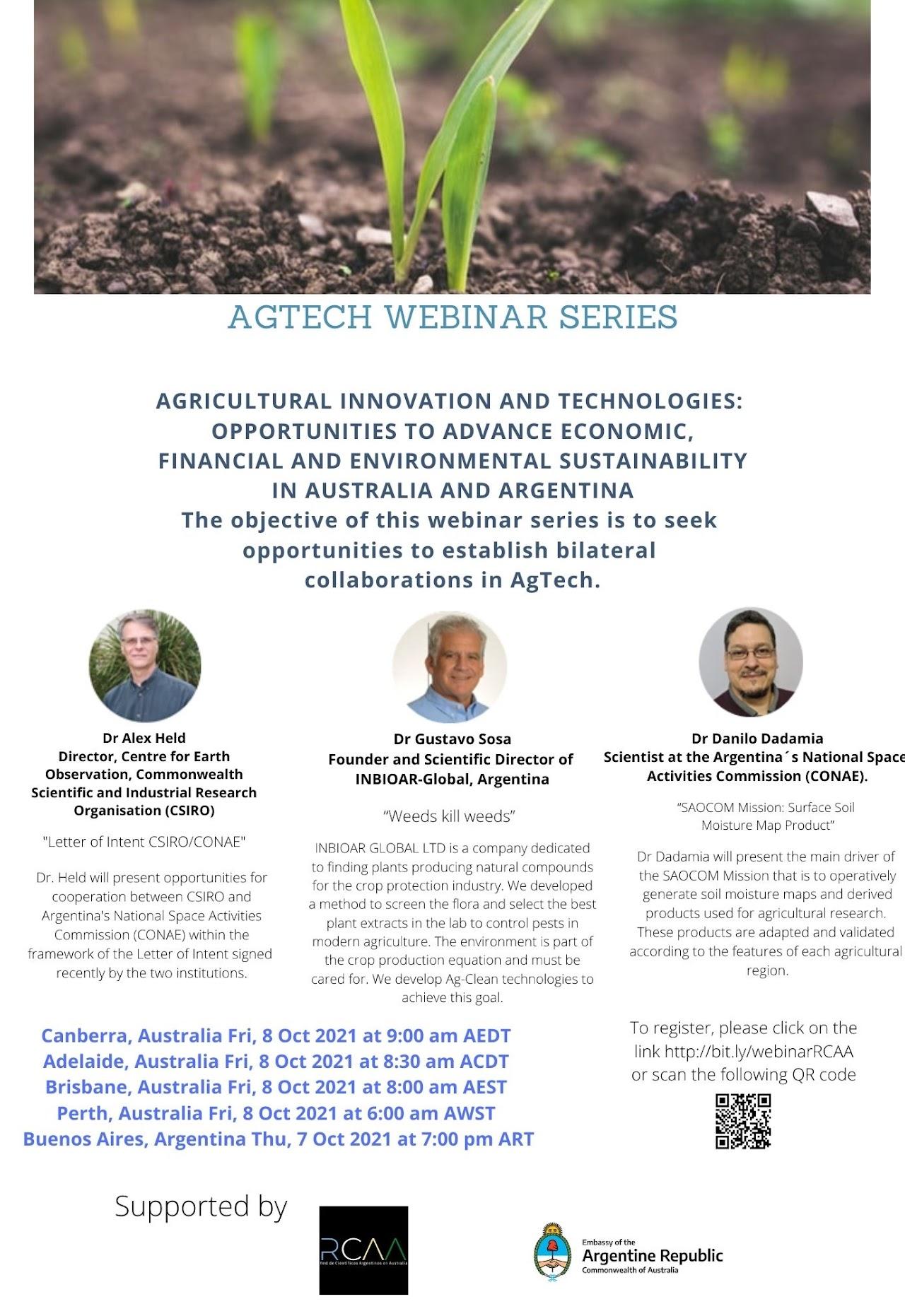
Second webinar in the AgTech series: satellite remote sensing, soil moisture from SAOCOM, and bio-inputs for crop protection, with the Argentine Embassy in Australia.
We thank the Embassy of Argentina in Australia, the coordinators and speakers for the great job to make this webinar possible.
Webinar highlights
AgTech represents one of the most promising fields for collaboration between Argentina and Australia. Both countries are global leaders in agriculture, so it makes sense that we should work together to strengthen our respective capabilities with regard to innovation in this field. In the coming decades we will need to produce more food in a more sustainable way. We will need to do it better than ever before. Hence, collaboration in AgTech, FoodTech and BioTech will be key to accomplishing these goals.
During the second AgTech webinar “Agricultural Innovation and Technologies: Opportunities to Advance Economic, Financial and Environmental Sustainability in Australia and Argentina”, we had the opportunity to learn from three speakers who briefly detailed successful cases of collaboration in the Ag and BioTech sectors of both countries.
First, Dr Alex Held from CSIRO commented on the Letter of Intent signed by Australia and Argentina to promote research collaboration in the area of space and remote sensing technology for earth observations. The agreement was signed between CSIRO and CONAE (the Argentine Space Agency).
Second, Dr Danilo Dadamia talked about the use of radar imagery for estimating soil moisture, which is a key resource to improve the sustainability of Ag systems worldwide. Dr Dadamia led the development of a soil moisture product derived from the SAOCOM satellite radar sensor. The product estimates topsoil water content (up to about 30 cm depth) and has been calibrated and validated in Argentina. Rigorous local calibrations are required to improve the confidence of these tools in other areas. In addition, a detailed eco-physiological analysis of the outputs of these products is needed by environment and management practice to provide better decisions for farmers and land managers.
Third, Dr Gustavo Sosa, director of INBIOAR-Global, shared his experience from the BioTech private sector in developing methods for detecting new natural compounds for crop protection. Weed resistance is a common problem in agriculture for Australia and Argentina. Natural chemicals that kill the weeds and remain only a few days in the soil are alternative products to conventional herbicides. A question is how these species are going to be cultivated in order to sustain their demand by the industry. Surely, some bottlenecks and risks related to the new resistances need to be considered, as well as the comparison of efficacy with conventional products.
The Network of Argentine Scientists in Australia promotes, via this webinar and other initiatives, the advance of scientific knowledge and opportunities for bilateral collaboration.
Panel
- Dr Alex Held — Director, Centre for Earth Observation, CSIRO — Letter of Intent CSIRO/CONAE
- Dr Gustavo Sosa — Founder and Scientific Director of INBIOAR-Global, Argentina — Weeds kill weeds
- Dr Danilo Dadamia — Scientist at Argentina's National Space Activities Commission (CONAE) — SAOCOM Mission: Surface Soil Moisture Map Product
Canberra, Australia: viernes 8 de octubre de 2021, 9:00 AEDT · Buenos Aires, Argentina: jueves 7 de octubre de 2021, 19:00 ART.